
You already have visible mold or water damage
Investigate and address the moisture source and affected materials. Dust testing is not required to recognize that the condition needs attention.
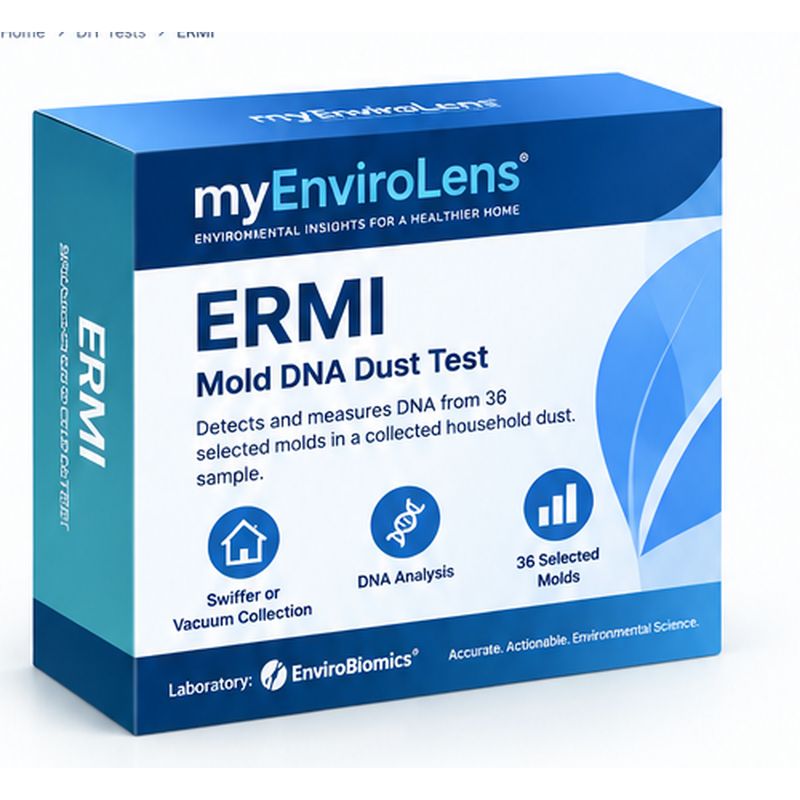
DIY DUST TEST · MOLD DNA
Environmental Relative Moldiness Index · Laboratory: EnviroBiomics
$240.00
ERMI measures DNA from 36 selected molds in collected household dust, including 26 associated with water-damaged buildings. The findings may provide clues about past conditions and help guide decisions about further investigation.
Each package is a separate test offering. Choose one to see what it measures; collection and turnaround are selected on that product's page.
Measures 26 water-damage-associated and 10 commonly encountered selected molds. Choose collection and turnaround below.
None. This is the standard 36-mold ERMI package.
You want information about selected molds in accumulated dust to help decide whether further building investigation may be useful.
Dust findings cannot establish whether mold is actively growing today or whether a home is safe.
Continue with Standard ERMIChoose any additional targets on the ERMI Plus product page.
You may select up to five additional laboratory targets on the ERMI Plus product page. They are optional, are not automatically included measurements, and not every available target is a mold. The order page shows the exact current targets and charges before you add the product to the cart; selecting none does not purchase any additional testing.
You have a specific question about one or more of the available targets beyond the standard ERMI panel.
Extra targets do not establish current growth, airborne exposure, personal dose, or a combined health-risk score.
Continue with ERMI PlusThe laboratory reports mold DNA and bacterial endotoxin separately; this is not a combined exposure or health-risk score. Continue to choose collection and turnaround.
Bacterial endotoxin is measured and reported separately from mold DNA; it is not another mold target.
You want the selected mold measurements and a separate environmental endotoxin measurement from the submitted sample.
The two results do not form a combined exposure or health-risk score.
Continue with ERMI + EndotoxinThe laboratory reports mold DNA, Actinobacteria markers, and bacterial endotoxin as three distinct measurements, not a combined exposure or health-risk score. Continue to choose collection and turnaround.
Actinobacteria and endotoxin are additional, distinct laboratory measurements; neither is part of the 36-mold ERMI score.
You want all three separately reported types of environmental measurements from the submitted sample.
The laboratory does not combine these findings into a home-safety or personal health-risk score.
Continue with Actino + Endotoxin + ERMIThe selected total and cart price update with your choices. Shipping is additional at checkout.
A professional reviews the results from the DIY tests you purchase through myEnviroLens, explains what the findings mean, and identifies practical next steps.
When your results are ready, confirm the tested property, complete a short questionnaire, and provide your reports through your homeowner account.
Included with qualifying DIY tests. Optional. You do not need to buy a consultation.
Loading secure product options, total and Add to Cart…
The secure options could not finish loading. Reload product options.
ERMI examines household dust for DNA from 36 selected molds: 26 associated with water-damaged buildings and 10 commonly found in indoor environments.
Dust may hold evidence of earlier conditions. The individual measurements provide context, but ERMI cannot determine on its own whether mold is growing in your home today.
Investigate and address the moisture source and affected materials. Dust testing is not required to recognize that the condition needs attention.
Look at the individual measurements alongside the building's history and observations. A physical investigation may be appropriate if concerns remain unexplained.
Do not assume there is no hidden moisture or mold problem. The result cannot rule out conditions outside the sampled dust.
Reports DNA measurements for 36 selected molds and a comparative ERMI score.
Use narrower selected mold panels with different purposes or reporting. A broader panel is not automatically a better choice.
ERMI measures mold DNA in collected household dust. The 36 individual measurements and the calculated ERMI score are related but different report outputs; the test does not measure every indoor mold.
Choose the Swiffer or Vacuum Kit option available for your order and follow the laboratory's supplied collection instructions. The Swiffer option collects dust from suitable hard surfaces; the Vacuum Kit option collects dust with the laboratory-approved vacuum method.
Collect dust from the selected sampling area and return it as directed. A single sample does not represent an entire property.
Your laboratory report includes measurements of 36 selected molds and a calculated ERMI score that provides a relative comparison of mold DNA found in your collected dust.
A high ERMI score does not, by itself, establish that a home is unsafe. Likewise, a low ERMI score does not establish that a home is safe or free of moisture and mold problems.
Dust may contain evidence of earlier conditions. The score cannot determine whether a related moisture or mold condition is present now or whether a previous problem has been corrected. Understanding current building conditions may require a physical investigation of moisture sources, building materials, and visible or concealed mold growth.
EPA developed ERMI for research and has not validated it for routine non-research residential assessment. ERMI is not a home-safety threshold, health diagnosis, personal-dose measurement, or remediation-clearance test. The finding cannot establish what is currently in room air.
Outbound kit shipping is calculated separately at checkout. Available UPS services and rates depend on your destination and the available checkout options. Follow the kit's instructions for returning the collected dust.
Describe what happened, what report or test you have, or what you are trying to decide.